
Human activities including pollution and climate change can dramatically alter ecological dynamics, affecting the distribution of species and how these species interact. Human impacts also exert strong selection pressure, resulting in rapid evolutionary changes. The resulting shifts in phenotypes (i.e. traits) can even influence ecological dynamics at the population, community and ecosystem scales. In other words, human activities can drive eco-evolutionary dynamics. Research in the Rogalski lab explores this intersection of ecology and evolution in human impacted environments with the goals of providing insight into basic biological questions and informing conservation and restoration work.
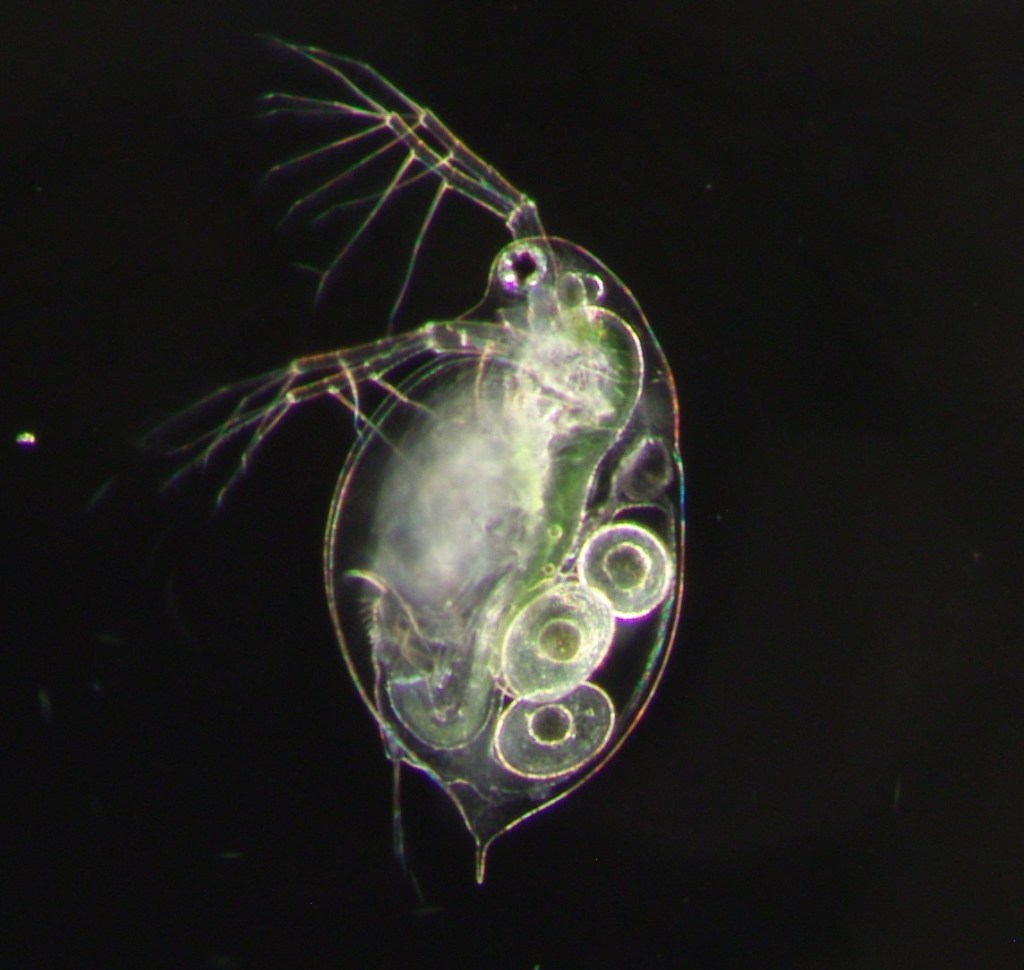
Much of our research involves a focal organism, Daphnia (aka “water fleas”): microscopic crustaceans commonly found in lakes and ponds. Daphnia are sensitive to chemical exposure and are a model system in toxicology work. Daphnia also provide an excellent study system for disease ecology, as their small, transparent bodies enable identification of microscopic parasites in living hosts. Daphnia can be collected from the field and cultured clonally in the lab, providing opportunities for experimental manipulation and examination of phenotypic variation. In addition, despite their small size Daphnia play a huge role in lake ecosystems. Daphnia have voracious appetites and can grow and reproduce rapidly – thriving Daphnia populations keep algal blooms in check and can influence nutrient cycling in lakes. Changes in Daphnia traits, population dynamics, or species composition can impact lake ecosystem dynamics. Below you’ll find examples of past and ongoing research
Ecological and evolutionary responses to salt availability
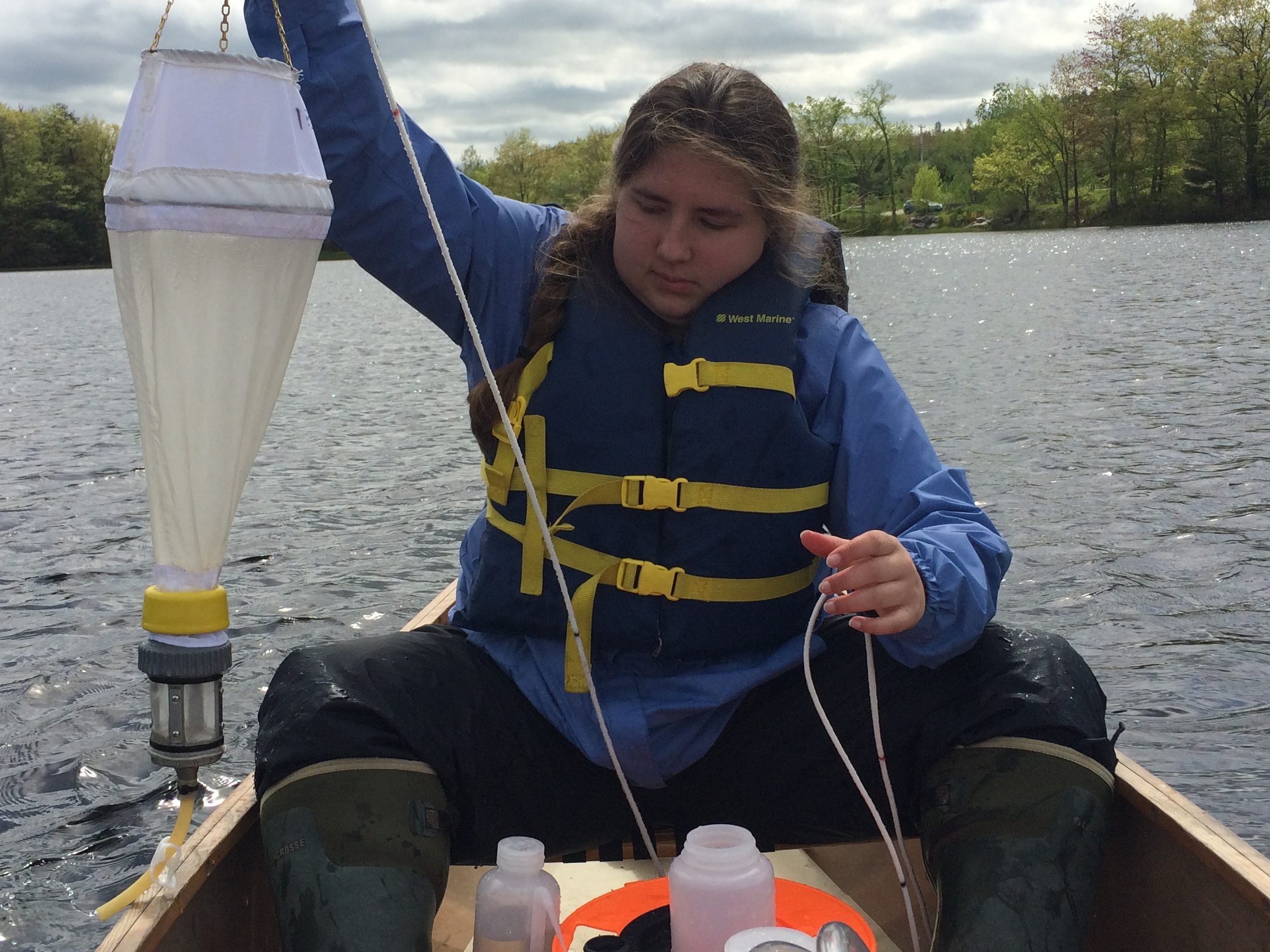
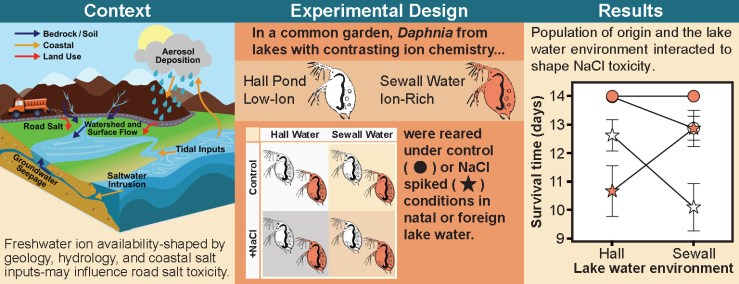
Salinization impacts freshwaters globally, yet the biotic impacts are understudied. Maine lakes tend to be fairly low in dissolved ions, but both natural and human inputs of salts (e.g., sodium, chloride, calcium, magnesium) have led to gradients in ion availability. Current research in the Rogalski lab is exploring the influence of ion availability on Daphnia traits and zooplankton community structure in habitats ranging from ion-poor to ion-rich. A key aim of work is to determine how both environmental and biological context may shape vulnerability to the salinization resulting from road salt application and saltwater intrusion. One key finding from is that the Daphnia populations in lakes with relatively ion-enriched conditions are likely to be less impacted by freshwater salinization, in part due to their adaptation to local lake water chemistry. Consequently, traditional toxicity tests using standard artificial lake water media are likely to underestimate NaCl toxicity for zooplankton inhabiting naturally ion-poor freshwater environments. We have also observed evidence of a Daphnia population losing and regaining salt tolerance alongside multi-year fluctuations in salinity driven by coastal flooding, rain, and drought events.
Related publications:
Mary A. Rogalski and Utku Ferah. 2023. Lake water chemistry and population of origin interact to shape Daphnia fecundity and growth. Ecology and Evolution, 13:e10176, doi:10.1002/ece3.10176.
Mary A. Rogalski, Elizabeth Baker, Clara Benadon, Christoph Tatgenhorst, and Brady Nichols. 2024. Lake water chemistry and local adaptation shape NaCl toxicity in Daphnia ambigua. Evolutionary Applications, 17:e13668, doi:10.1111/eva.13668.
O. Chambers, S. Burchell, B. Nichols, K. Kulzy, M. A. Rogalski*. (2025) Rapid evolutionary response to salinity fluctuations in a coastal Daphnia population. American Naturalist, doi: 10.1086/737753

Century scale impacts of pollution on Daphnia
Lake fertilization can have significant long-term consequences for the structure of ecological communities. Excess levels of nitrogen and phosphorus can fuel nuisance algal blooms, which may drive down oxygen levels in lake bottoms and even cause fish kills. One common practice to control nuisance algal blooms is to apply copper sulfate as an algaecide. I used a paleolimnological approach to examine how daphniid zooplankton assemblages shifted in response to eutrophication and associated copper sulfate use. We found that Daphnia species diversity increased with nutrient pollution over time, though copper sulfate use strongly influenced colonization and extinction patterns. I was especially interested in whether Daphnia were able to adapt to increasing copper exposure experienced during copper sulfate application. Using a “resurrection ecology” approach, which involves hatching Daphnia from resting eggs in lake sediment to examine their traits, I found that Daphnia were evolving, but they were becoming more sensitive to copper exposure following decades of increasing exposure. That is, Daphnia in these lakes became maladapted to acute metal exposure.
Related publications:
M. A. Rogalski, D. K. Skelly, and P. R. Leavitt. 2017.Daphniid zooplankton assemblage shifts in response to eutrophication and metal contamination during the Anthropocene. Proceedings of the Royal Society of London B: Biological Sciences,284:20170865, doi:10.1098/rspb.2017.0865
M. A. Rogalski. 2017. Maladaptation to acute metal exposure in resurrected Daphnia ambigua clones after decades of increasing contamination. American Naturalist, 189:443-452, doi:10.1086/691077
M. A. Rogalski. 2015. Tainted resurrection: Metal pollution is linked with reduced hatching success and high juvenile mortality in Daphnia egg banks. Ecology 96(5):1166-1173, doi:10.1890/14-1663.1
Environmental impacts on host-symbiont interactions

Daphnia are hosts to a diverse community of parasites that grow and reproduce in their hemolymph, gut wall, or even hitch a ride on their carapace. Parasites including Metschnikowia, Pasteuria, and Gurleya are “obligate killers”, releasing spores into the lake water column that may be consumed by another host after killing their previous host. Environmental context can strongly shape species interactions, either through direct effects on on or both species or through more complex indirect effects. While the intimate coevolutionary relationship between hosts and their parasites has long been appreciated, we found evidence that environmental stress associated with UV exposure impacts Pasteuria evolution and that in turn may affect how this virulent parasite interacts with its Daphnia host. Not only can environmental and ecological context influence the strength of host-parasite interactions, we have also observed a shift from parasitism to mutualism along ecological gradients. In Michigan lakes we commonly observed a microsporidian gut symbiont nicknamed MicG which appears to reduce host fitness when resources are relatively scarce and benefit host fitness when other more virulent parasites are common. Considering interactions among the abiotic environment, hosts and their parasites certainly increases the complexity of field and laboratory experiments but may also provide valuable insight into untangling these ecological and evolutionary dynamics.
Relevant publications
M. A. Rogalski, T. Stewart Merrill, C. D. Gowler, C. A. Cáceres, and M. A. Duffy. (2021) Context dependent host-symbiont interactions: shifts along the parasitism–mutualism continuum, American Naturalist, 198(5): 563-575, doi:10.1086/716635
M. A. Rogalski and M. A. Duffy. 2020. Local adaptation of a parasite to solar radiation impacts disease transmission potential, spore yield, and host fecundity. Evolution, 74(8): 1856-1864, doi: 10.111/evo.13940
M. A. Rogalski, C. D. Gowler, C. L. Shaw, R. A. Hufbauer, and M. A. Duffy. 2017. Human drivers of ecological and evolutionary dynamics in emerging and disappearing infectious disease systems. Philosophical Transactions of the Royal Society B: Biological Sciences. 372:20160043, doi:10.1098/rstb.2016.0043
 Mary A. Rogalski, PhD